This week's news from Google confirmed what anyone watching the health tech space already knew: the race to own Health OS is on.
From Fitbit, Apple Watch, Samsung Health, Oura, Google Health Connect, Gemini AI health features, and similar platforms, every major tech platform is in a sprint to become the default operating system for human health data. The investment is real. The technology is impressive. The ambition is enormous. And for the 1.8 billion people actively managing a wearable and a wellness app, this race matters.
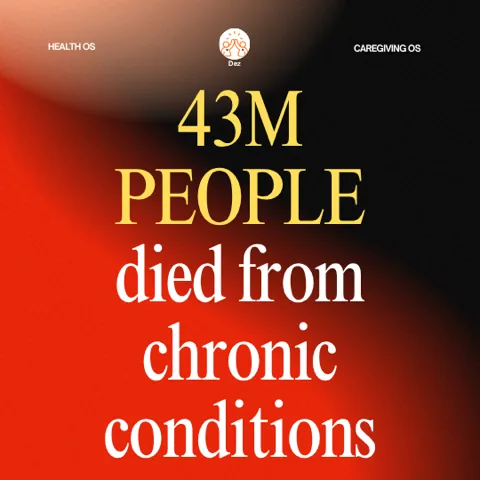
But here's the number nobody in the Health OS race is talking about: 43 million. That is how many people died from non-communicable diseases in 2021. Seventy-five percent of all global non-pandemic deaths. Diseases that don't kill quickly. They progress slowly, at home, invisibly, between clinical appointments, in the daily signals nobody is currently capturing.
The Health OS race is solving a real problem. It is just not solving that one.
About Health OS
Health OS is a device-to-consumer architecture. The intelligence flows one way: device collects passive biometric signals → data aggregates in the cloud → consumer app surfaces insights → individual user acts.
This architecture has real strengths. For the mostly healthy person who wants to sleep better and move more, it is genuinely useful. But it has a fundamental assumption baked in at the foundation: there is one user, they are managing their own health, and they have the agency and capacity to engage with the platform every day.
That assumption excludes the people dying at the rate of 43 million a year.
The Architecture Problem No One Is Naming
Think about who actually lives with a non-communicable disease at home. A person with dementia who cannot reliably report their own symptoms. A person with schizophrenia whose medication adherence is the difference between crisis and stability. A stroke survivor whose caregiver notices small changes: the slight drag, the morning confusion lasting a little longer, or other shifts that never make it into any clinical record.
These people need health monitoring more than anyone else. And they are the least served by the device-to-consumer model.
Three structural reasons:
- Device dependency excludes the highest-need population. A wearable assumes a self-sufficient, engaged user. Caregiver-dependent populations are excluded by design.
- Individual-only architecture is blind to the most valuable data source in home care. The caregiver sees more than any device and is architecturally invisible in every Health OS platform that has ever been built.
- Population averages cannot see personal deviation. Measuring someone against a population range produces noise. Measuring them against their own longitudinal pattern produces signal: a 48- to 72-hour compound shift that precedes a clinical crisis.
About Caregiving OS
Caregiving OS is not a better version of Health OS. It is a different architecture entirely: the operating system for care relationships. Both the caregiver and the dependent person have an active simultaneous voice, and the intelligence layer synthesises both streams to detect what neither could see alone.
It requires multimodal daily capture across 15+ dimensions: medication confirmation, mood, pain, sleep, nutrition, hydration, cognition, environment. And it requires a care intelligence layer built on personalised temporal baseline modelling that learns what this person's normal looks like, and compound anomaly detection that flags shifts across multiple dimensions before they manifest clinically.
The Gap
Every major player, from trillion-dollar tech giants to well-funded startups, is racing to own Health OS. And few are building Caregiving OS, honing in on chronic disease and pain management.
My brother manages schizophrenia. He used an early version of Dez daily for 12 weeks. He has had one GP visit since, compared to every three weeks previously. These are signals, not studies. But they point at something real.
The Health OS race is important. But it is leaving 75% of global deaths unaddressed. Not for lack of capability but because of architecture. The infrastructure families actually need doesn't look like a better wearable. It looks like an operating system for caregiving.